

- Home
- Drilling Optimization
- Products
- Reamer
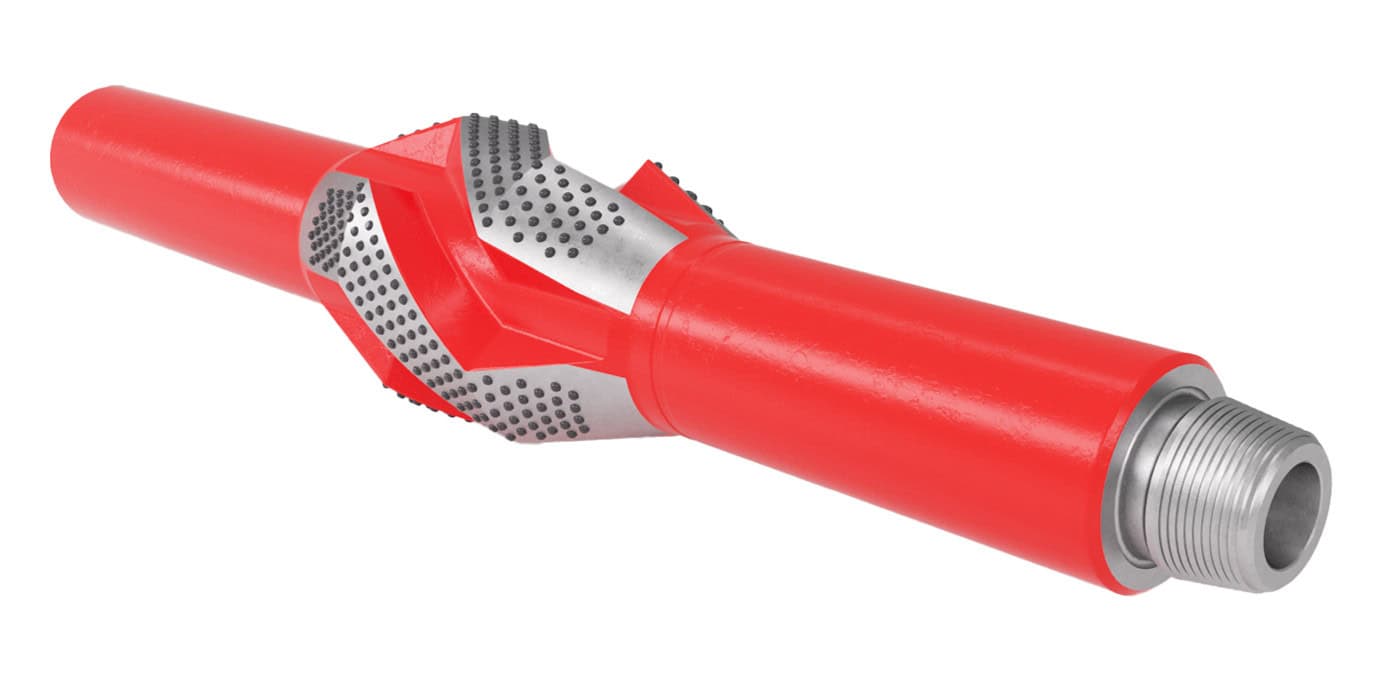
Reamer® BDR (Bladed Drilling Reamer)
The Paradigm Reamer® is designed to deliver a smooth in-gauge wellbore – our Reamers eliminate ledges, correct undergauge intervals, reduce drilling inefficiency and minimize operational challenges in the next stage of running casing and completions.
Overview
Paradigm Reamer® are built to enhance wellbore quality while minimizing vibration and torque fluctuations. The design promotes consistent directional control, reliable gauge retention, and durability in challenging formations. In addition to stabilizer functionality, the Paradigm Reamer® incorporates an optimized cutting structure that effectively removes ledges and mitigates micro-doglegs, resulting in a smoother, more uniform wellbore profile.
Applications
The Paradigm Reamer® has consistently proven its value in applications where the key performance indicator is reducing rig time by minimizing reaming and back-reaming operations. It is particularly effective in wells with challenging trajectories, where ledge formation, tight spots, and micro-doglegs are unavoidable. In these conditions, the diamond-impregnated cutting structure actively mitigates such issues, promoting smoother wellbores and improved drilling efficiency.
The durability of the Paradigm Reamer®’s cutting structure has been repeatedly demonstrated in applications where conventional stabilizers and tools return undergauge. In contrast, the Paradigm Reamer® reliably maintains gauge, delivering consistent performance and extended run life.
Features and Benefits
- Reduces drill string wear and fatigue
- Minimises torque and drag
- Minimises casing wear
- Can help to reduce mechanical cave-ins
- Improves drilling efficiency
- Dampens vibration
Paradigm’s Reamer® features a high-quality diamond-impregnated cutting inserts that actively engage the formation to deliver a smoother wellbore. These diamond impregnated inserts function similarly to a grinding wheel—the cutting face continuously renews itself as drilling progresses, exposing fresh, sharp diamonds as wear occurs. This self-sharpening behaviour ensures sustained cutting efficiency throughout the run.
The low-friction factor of the diamond-impregnated inserts reduces torque generated by the cutting structure, improving drilling performance. Designed to maximize cutting efficiency, the inserts significantly extend tool life while maintaining gauge, even in challenging formations containing chert nodules. A proprietary diamond and binder formulation provides superior durability, offering greater resistance to chipping and breakage compared to conventional PDC inserts.
Paradigm Reamer® designs incorporate a low taper angle to minimize the risk of hang-ups. Optimized fluid bypass channels provide maximum flow area to enhance active hole cleaning. The reamer® is capable of both reaming and back-reaming operations, ensuring reliable performance while drilling and when pulling out of hole.
FAQ
Why are Reamer®s run while drilling rather than correcting hole issues later?
Reamer®s are run while drilling to actively control wellbore quality before problems escalate into costly, irreversible events. Conditioning the hole in real time reduces the formation of ledges, tight spots, and under-gauge intervals that can prevent casing from reaching bottom on the first run. When casing cannot be landed as planned, operators face expensive reaming trips, liner contingencies, or even sidetracks – often at a significantly higher cost than proactive hole conditioning.
Poor borehole quality also delays the ability to isolate formations. Extended exposure of unstable, reactive, or depleted zones increases the risk of hole collapse, swelling, fluid losses, and differential sticking. These risks grow rapidly once drilling stops and remedial operations begin. Running a reamer® while drilling helps preserve gauge and stability, enabling casing to be set promptly and reducing non-productive time associated with hole degradation.
By maintaining a smooth, uniform wellbore throughout the drilling process, reamers protect downstream operations such as casing, cementing, and completion. The result is a lower-risk well construction process, improved operational efficiency, and a significantly reduced likelihood of high-cost interventions caused by avoidable hole quality issues.
How does a Reamer® improve overall wellbore quality?
Reamer®s smooth irregularities created by bit wear, formation changes, or directional drilling effects. This results in a rounder, more uniform hole that supports efficient casing, cementing, and logging operations.
What is torque and drag? Why do Paradigm Reamer®s assist in torque and drag reduction?
Torque is the rotational resistance encountered when turning the drill string. It is influenced by friction between the drill string and the wellbore, as well as by downhole conditions such as hole irregularities, cuttings buildup, and tool contact with the formation. Excessive torque can lead to vibration, stick-slip, tool damage, and reduced drilling efficiency.
Drag is the axial resistance to moving the drill string in or out of the wellbore. High drag limits the ability to apply weight to the bit, complicates tripping operations, and increases the risk of stuck pipe. Drag becomes more pronounced in deviated, horizontal, and extended-reach wells where the drill string has sustained contact with the wellbore wall.
Together, torque and drag are indicators of wellbore condition and directly affect drilling performance, directional control, and operational risk.
Why a Paradigm Reamer® Helps – Paradigm reamers reduce torque and drag by continuously conditioning the wellbore as it is being drilled. Many of the forces that drive torque and drag originate from poor hole geometry – such as ledges, spiraling, micro-doglegs, under-gauge sections, and uneven wear caused by directional drilling. Reamers engage these features in real time, smoothing the wellbore and restoring gauge before friction levels escalate.
By creating a more uniform and concentric hole, reamers reduce localized contact points where the drill string would otherwise contact unevenly. This lowers rotational resistance, resulting in a smoother torque response at surface and more consistent rotation downhole. Improved hole condition also allows axial movement of the drill string with less resistance, reducing drag and improving weight transfer to the bit (also enhanced further by the Paradigm Driver® tool).
In high-angle and extended-reach wells, reamers play an even more critical role. Sustained side loading in these wells amplifies friction effects, making small irregularities disproportionately impactful. Reamer®s help manage these conditions by maintaining stable hole geometry, which minimizes torque spikes, reduces vibration, and supports efficient rotary steerable system performance.
Lower torque and drag have downstream benefits beyond drilling efficiency. A conditioned wellbore simplifies casing and liner installation, reduces the need for backreaming or clean-out trips, and lowers the likelihood of stuck pipe events.
Ultimately, reamers serve as a preventive control mechanism – addressing the root causes of torque and drag rather than reacting to their consequences.
Why are Reamer®s important in directional and extended-reach wells?
Highly deviated and horizontal wells are prone to hole deformation. Reamers help maintain gauge and smooth transitions, which minimizes drilling dysfunctions and improves the ability to reach target depth efficiently.
Extended-reach wells amplify the cost of drilling inefficiencies. Paradigm reamers help control torque and drag throughout the wellbore, enabling smoother drilling and fewer corrective runs. Their robust architecture and low-cost redress capability deliver long service life and reduced total ownership cost compared to competitive reamer designs.
Directional drilling places high demands on downhole tools, especially when paired with rotary steerable systems. Paradigm reamers are successfully deployed with every major RSS, helping preserve directional accuracy while reducing vibration and torque fluctuations. Their durable design and high diamond content ensure predictable performance even in extended lateral sections.
How do Paradigm Reamer®s contribute to drilling efficiency and cost control?
Paradigm reamers support drilling performance while protecting downstream operations. A high-quality wellbore improves completion reliability, production access, and intervention efficiency over the life of the well.
Paradigm domed diamond insert reamers have a technical advantage in torque response over purely PDC-based designs because of how their cutting elements interact with the formation and manage contact forces along the wellbore.
Domed diamond inserts engage the formation with a rolling and almost burnishing action rather than a purely shearing cut. This contact mechanism distributes load more evenly across the cutter surface, reducing sudden depth of cut changes that commonly generate torque spikes in aggressive PDC cutters. As a result, torque response remains smoother and more predictable, especially in interbedded or variable formations. A common directional driller comment about Paradigm reamers is their smooth torque response.
Pure PDC reamers rely on sharp cutting edges that are highly sensitive to changes in formation strength and cutter engagement. When formation hardness varies, PDC cutters can alternately dig in and release, creating oscillations in torque and increasing the risk of stick-slip and torsional vibration. Domed diamond inserts, by contrast, are less prone to abrupt engagement, providing a damping effect that stabilizes rotational resistance.
The domed geometry also tolerates higher side loads without edge chipping or cutter overload. In directional and extended-reach wells – where reamers experience continuous lateral forces – this durability helps maintain consistent contact with the borehole wall, preventing uneven cutting that would otherwise cause erratic torque behavior.
Additionally, domed diamond inserts maintain effectiveness as they wear. Instead of losing aggressiveness abruptly, the contact area gradually increases, preserving controlled cutting action and consistent torque over a longer run. This wear behavior contrasts with PDC cutters, which can experience sudden performance degradation once edges are compromised.
Together, these characteristics allow Paradigm domed diamond insert (DDI) reamers to deliver smoother torque response, reduced vibration, and more stable drilling performance than purely PDC designs – particularly in complex well trajectories where torque control is critical to drilling efficiency and tool longevity.
Contact Paradigm
Do you wish to discuss a project, have a technical product application question or need to know more about a product or service? Leave us your contact details and an expert from our team will be in touch with you shortly.
Paradigm Group BV is committed to protecting and respecting your privacy, and we’ll only use your personal information to administer your account and to provide the products and services you requested from us. From time to time, we would like to contact you about our products and services, as well as other content that may be of interest to you. You can unsubscribe from these communications at any time. For more information on how to unsubscribe, our privacy practices, and how we are committed to protecting and respecting your privacy, please review our Privacy Policy. By clicking submit button, you consent to allow Paradigm Group BV to store and process the personal information submitted above to provide you the content requested.