

Dry Testing
- Home
- Fire Protection
- Optimized Solutions
- Dry Testing
Overview

Dry Testing is Paradigm’s waterless way to verify deluge system functionality using pressurised, conditioned air and measured data, rather than flowing firewater. It is ideal for operators and duty holders who need clear evidence of performance while reducing disruption to people, plant and production.
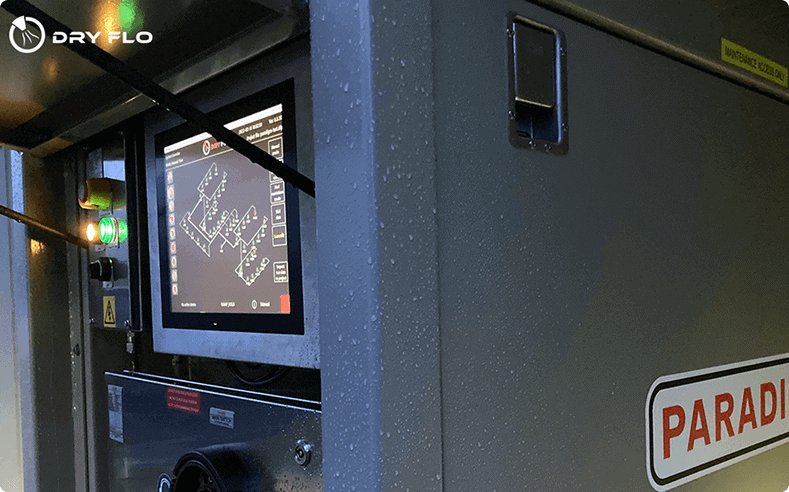
Using Dry-Flo®, we flow low pressure air through the deluge network and measure indication points in the pipework. Within minutes, the software samples readings to confirm whether the system is functional and aligned with its original design intent, and it highlights where restrictions may exist.
Applications
Dry Testing is applied across deluge and water based fire suppression systems where a wet test creates avoidable risk, cost, or logistics. Typical workflows include commissioning, periodic compliance checks, and troubleshooting when performance is suspected to be degrading over time.
Offshore and marine (including FPSO/FLNG): wet tests can leave residual seawater in open deluge pipe networks, which can drive corrosion, scaling and microbiologically influenced corrosion that creates flow restrictions and nozzle blockages. Dry Testing avoids introducing more water while still verifying functionality.
Oil, gas and petrochemical plants: where wet testing can mean extensive preparation, wastewater handling, and the risk of water ingress into electrical equipment. Dry Testing supports performance verification with minimal impact on operations.
Infrastructure projects such as tunnels: where water spray, pooling, and wastewater disposal can slow construction activity and create safety hazards. Dry Testing can be scheduled earlier and run with fewer constraints.
Sensitive facilities (data centres, pharma, power): where water exposure can cause downtime, contamination risk, or equipment damage, while evidence and traceability remain essential.
Benefits
Dry Testing delivers practical outcomes that matter to safety, compliance, uptime and integrity:
- Avoids corrosion drivers from wet testing: no added seawater or residual moisture that can accelerate internal corrosion, CUI risk, and nozzle blockage. That helps preserve system reliability between major overhauls.
- Keeps operations moving: testing can be performed on live systems and avoids many wet test preparations such as equipment bagging and post test clean up. That reduces disruption to production and work scopes.
- Pinpoints restrictions fast: the software provides graphical and numerical outputs and shows where the issue sits in the system, enabling targeted inspection and remediation instead of blanket maintenance.
- Cuts water use and logistics: on a major tunnel commissioning program, 678 zones were tested in 13 weeks with 11 million litres of water saved and 528 water truck journeys avoided.
- Reduces testing time where it counts: that same program reported a 75% reduction in average test time per zone versus wet testing, helping keep commissioning schedules under control.
- Creates repeatable, recordable evidence: results can be trended and compared to baseline requirements, supporting audit readiness and informed maintenance planning.
FAQ
What is dry deluge testing, in plain terms?
It is a way to confirm deluge system performance without flowing water. We use low-pressure, conditioned air and measurements at selected points to verify the system is functional and consistent with its original design.
Does Dry Testing replace wet testing completely?
Dry Testing is used to reduce disruption and corrosion exposure and to provide repeatable, data-led verification. Whether it substitutes wet tests, and for how long, depends on your duty holder requirements and verifying authority. Dry-Flo® is qualified and certified for its intended use, and is used as a waterless alternative within many testing strategies.
Do we need to shut down the deluge system during the test?
In many cases, testing can be performed while the deluge system remains live, which helps avoid interruption to protected operations. The exact setup depends on the system configuration and site constraints.
What problems can Dry Testing detect that wet testing might miss?
Dry Testing provides measured feedback across the system and can pinpoint restrictions and underperformance in pipework and nozzles. This supports early detection of internal debris and degradation that may not be obvious during a wet test where only a small number of nozzles are typically observed.
What do we need to provide on site (air, access, permits)?
We define the minimum airflow requirements as part of the procedure so the client can plan the air supply. We also agree access to deluge valve areas and selected measurement points, plus any permits required for work in live firewater systems.
About Paradigm Fire Protection Services
Paradigm Fire Protection Service offers performance based deluge testing technologies and remediation services.
Save cost, reduce operational disruption and increase asset lifespan with Paradigm Dry Deluge Testing: The only verified dry deluge test in the world Dry-Flo® testing involves flowing low-pressure, dried air into the deluge system. At low pressures air replicates the flow of water exactly, enabling us to take readings throughout the deluge system to prove compliance. Our software package processes this information to give live data in both a graphical and numerical format so the operator can quickly identify whether a system is compliant. If this isn’t the case the software can immediately show the operator where the issue is within the system, allowing our technicians to inspect and remediate as necessary. Dry-Flo® has been qualified in accordance with DNV-DSS-401, Technology Management /1/ and DNV GL considers it qualified for its intended use following DNV RP-A203 /2/ and is currently undergoing Bureau Veritas and Lloyds Register certification procedures.
Contact Paradigm
Do you wish to discuss a project, have a technical product application question or need to know more about a product or service? Leave us your contact details and an expert from our team will be in touch with you shortly.
Paradigm Group BV is committed to protecting and respecting your privacy, and we’ll only use your personal information to administer your account and to provide the products and services you requested from us. From time to time, we would like to contact you about our products and services, as well as other content that may be of interest to you. You can unsubscribe from these communications at any time. For more information on how to unsubscribe, our privacy practices, and how we are committed to protecting and respecting your privacy, please review our Privacy Policy. By clicking submit button, you consent to allow Paradigm Group BV to store and process the personal information submitted above to provide you the content requested.