
Overview
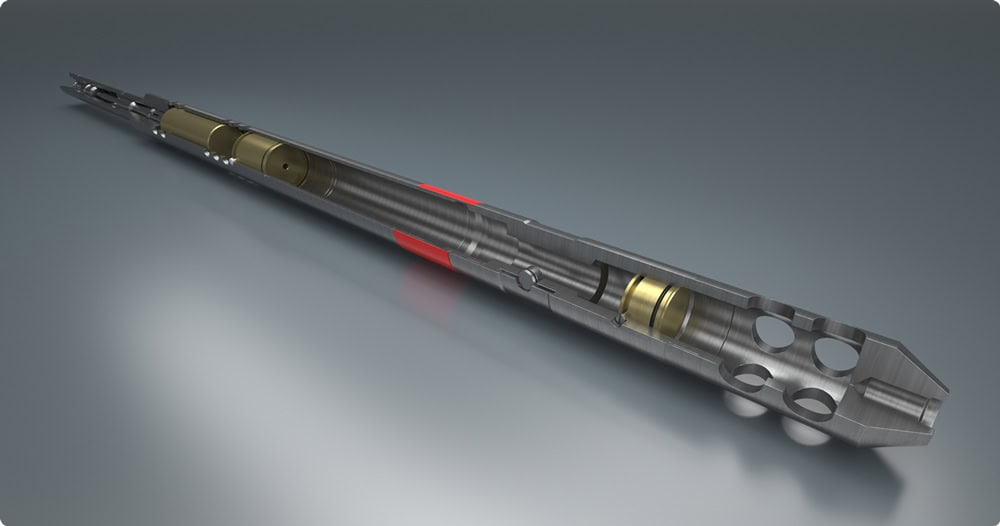
Contaminated cement leads to poor zonal isolation, failed well barrier tests, remedial operations, and ultimately increased well abandonment costs.
Why It Happens
In a wellbore environment, the bailer is exposed to wellbore fluid pressure and temperature during the run-in. Without positive displacement, cement is in contact with wellbore fluids throughout the journey downhole, allowing dilution and contamination before placement. The result is cement of inconsistent quality, inadequate setting, and unreliable plug performance.
How It Can Be Fixed
Use a Positive Displacement Bailer (PDB) that physically separates the cement from wellbore fluids during deployment using an internal flush piston. The piston is triggered by a weight bar at depth, displacing the full cement charge at the target location cleanly and precisely, preventing stringing of cement uphole on retrieval.
Why Paradigm
Paradigm Intervention Technologies offers the Positive Displacement Bailer (PDB) system, deployable on Slick-E-Line®, e-line, and conventional slickline. Its non-explosive activation, isolation of cement from wellbore fluids, and ability to work in deviated wells make it a reliable solution for precise plug placement. Paradigm also provides the Slick-E-Line® platform for real-time depth confirmation during PDB operations.
Explore the technology
Related services
A Digitally Enabled Slickline System combines the simplicity of traditional slickline operations with the real-time data capabilities of electric line technology. This hybrid approach allows operators to perf…