

- Home
- Drilling Optimization
- Products
- Driver
Resources
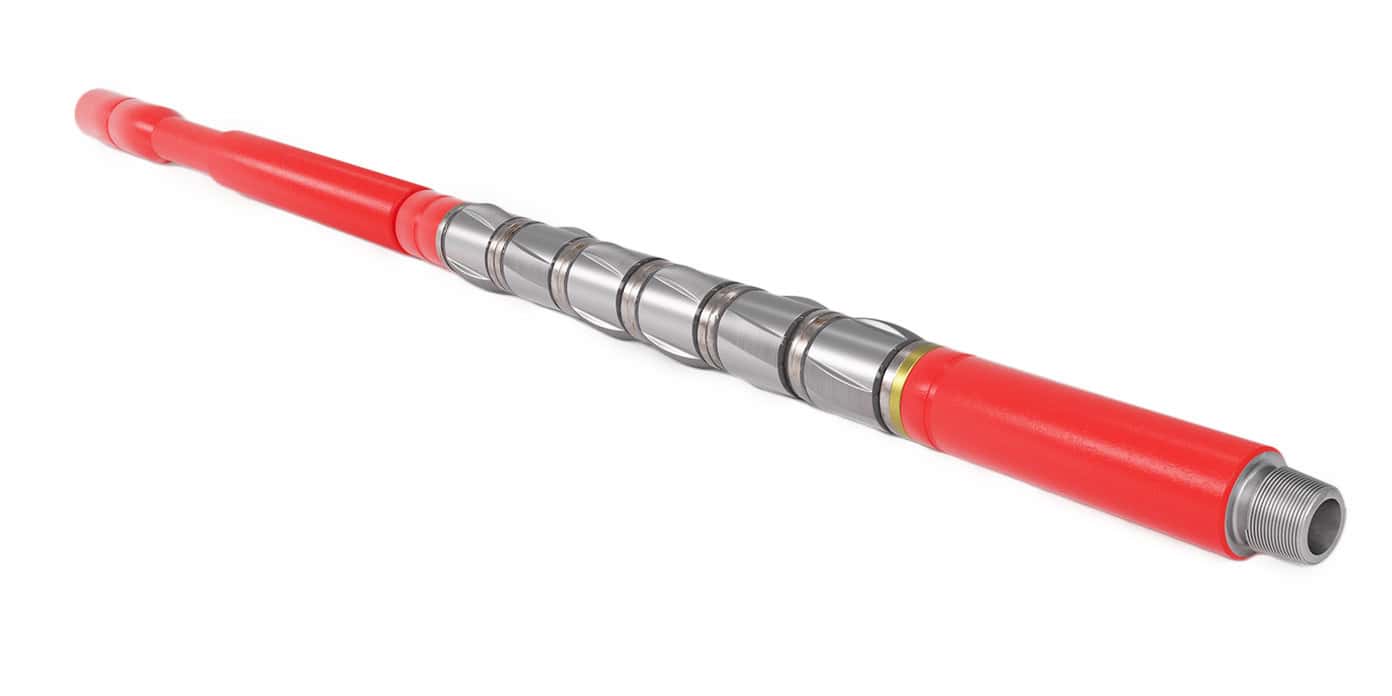
Driver® TDC (Traction Drill Collar)
Physics does the heavy lifting. Recycles borehole side force into productive axial thrust – no agitator, no power section, no added hydraulic cost. Buckling reduces, effective WOB rises, vibrations (axial, lateral) collapse. Bits stay aggressive longer; penetration accelerates. Simple mechanical upgrade for complex wells.
“Patented and category defining – it’s unique to the market. Welcome to Paradigm”
Overview
The Driver® is a category-defining, mechanical downhole traction tool that makes drilling faster and smoother in long horizontal or extended-reach wells.
It uses six outer rollers that tactically engage along the wellbore low-side as the drill string turns. These rollers convert wasted side friction into forward-pushing axial thrust -pulling the lower drill string straight, reducing buckling and delivering more weight directly to the bit.
No extra power, no mud pressure drop, no interference with MWD signals – just smart physics that:
- Cuts buckling and friction losses
- Improves weight-on-bit transfer for consistent, higher effective WOB
- Reduces axial, lateral, and torsional vibrations (including stick-slip)
- Protects bits and BHA components for longer life
- Boosts rate of penetration
- Improved RSS and MWD life (increased MTBF).
Plug it in above your BHA like any other sub and see smoother drilling, fewer trips, and lower costs – especially in challenging longer laterals where conventional tools struggle.
“Focus on your differential pressure with and without Driver® in the hole – a good drilling engineer sees the change – and also the value – straight away”
Applications
The Driver® excels in challenging drilling scenarios where buckling, friction, vibration, and poor weight transfer limit performance:
- Long horizontal and extended-reach laterals
- High-angle/deviated wells with significant doglegs or tortuosity
- Shale plays and tight-oil formations (e.g., Permian, Eagle Ford, Vaca Muerta)
- Deepwater and offshore extended-reach drilling
- Wells with high side loads, stick-slip, or axial/lateral vibration issues
- Rotary steerable system (RSS) and conventional BHA operations
- Applications requiring maximized ROP, extended bit life, and reduced non-productive time
It delivers reliable traction and dynamics improvement without pressure drop or MWD interference, making it ideal for complex trajectories where conventional tools underperform.
Features & Benefits
Paradigm Driver® – Features and Benefits
The Challenge
In long horizontal laterals, extended-reach wells, and high-angle trajectories, drilling engineers frequently battle drillstring buckling, excessive friction and torque, poor weight on bit (WOB) transfer, and destructive stick-slip, axial vibration, lateral vibration, and torsional vibration. These dynamics cause inconsistent cutter engagement, accelerated PDC bit wear, reduced ROP, frequent tool failures, and elevated non-productive time (NPT) – driving up costs and limiting reach in shale plays, tight-oil formations, and deepwater projects. Conventional BHAs lose significant surface-applied weight to parasitic drag and buckling before it reaches the bit, compromising efficiency and well economics.
How Driver® Solves It
The Driver® is a purely mechanical, physics-based traction tool that recycles wasted side-load energy into productive axial thrust – no agitator, no power section, no pressure drop, and zero interference with MWD/LWD signals.
Key Features & Benefits
- Six outer rollers in alternating pairs – generate forward axial thrust while stabilizing the BHA; converts frictional side load into useful string tension.
- Buckling prevention & superior WOB transfer – pulls the lower drillstring straight, minimizes compressive buckling, and delivers higher, more consistent effective weight on bit for precise depth-of-cut control.
- Multi-axis vibration suppression – dramatically reduces axial, lateral, stick-slip (low frequency torsional) and torsional vibration through continuous “caterpillar” motion and dynamic stabilization – protecting cutters and extending BHA and bit life.
- ROP acceleration & cost reduction – sharper, longer-lasting PDC bits + maximized WOB transfer yield higher penetration rates, fewer trips, and significant NPT reduction.
- Seamless integration – full-bore ID, no hydraulic demand, compatible with RSS, rotary, and sliding modes – plug-and-play enhancement for directional drilling optimization in complex wells.
FAQ
How does the Driver reduce drillstring buckling?
The axial thrust generated by the Driver pulls the lower drillstring out of compressive buckling. In long laterals, applied surface weight is often absorbed by buckling and friction before it reaches the bit. By reducing buckling, the Driver straightens and stabilizes the lower BHA, allowing a greater portion of surface-applied weight to be transmitted downhole. This increases effective weight on bit, improves drilling efficiency, and stabilizes downhole dynamics in high-angle and horizontal wells.
How does the Driver improve weight on bit efficiency?
The Driver increases the correlation between surface-applied weight and downhole weight on bit by minimizing friction and buckling losses. When buckling is reduced, more of the applied hook load is converted into useful bit load rather than being consumed by mechanical deformation. This means higher and more stable effective WOB at the bit. Improved weight transfer results in more consistent cutter engagement, improved depth of cut control, and increased rate of penetration.
How does the Driver translate side load into axial thrust?
The Driver converts a percentage of drillstring side load, which is normally lost as friction, into useful axial thrust. As the tool rotates, its outer rollers engage the borehole wall, generating a lifting and forward-driving force. This transforms lateral contact energy into forward motion along the wellbore. Instead of dissipating energy through drag, the Driver recycles it into axial thrust that helps advance the drillstring. This elegant energy conversion is what allows the tool to improve drilling efficiency without adding external power or pressure losses.
How does the Driver improve bit performance and ROP and why does the Driver not create pressure loss or interfere with MWD signals?
By reducing vibration, stick-slip, and buckling, the Driver minimizes mechanical damage to PDC cutters. Less vibration means cutters stay sharper for longer, maintaining efficient rock cutting. At the same time, improved WOB transfer ensures higher and more consistent bit loading. The combination of sharper cutters and higher effective WOB can directly increase rate of penetration. This produces faster drilling with improved bit life and reduced trip frequency.
The Driver has a full internal pass-through diameter and contains no internal power section or flow-restricting components. Unlike agitators that rely on mud flow to drive a power section, the Driver operates purely through mechanical interaction with side load. This means it introduces no additional pressure drop and does not degrade MWD signal-to-noise ratio. Hydraulic performance remains unchanged while drilling dynamics are actively improved.
How does the Driver control axial and lateral vibration and is still considered a physics-based, energy-efficient tool?
The Driver’s six outer rollers operate in three alternating pairs that create a continuous “caterpillar” effect along the wellbore. The on-duty rollers generate axial thrust while the off-duty rollers stabilize the tool and prevent precession. This simultaneous thrust and stabilization suppress both axial and lateral vibration. By keeping the drillstring dynamically stable and preventing erratic motion, the Driver protects BHA components and maintains consistent drilling behavior that reduces axial and lateral vibration.
The Driver does not consume energy from the drilling system; it recycles energy that already exists. Side load that would normally appear as frictional loss is converted into useful axial thrust. This allows the Driver to mitigate buckling, vibration, and stick-slip without adding hydraulic demand or mechanical complexity. From a physics perspective, it is an elegant solution that transforms wasted energy into productive drilling force while simultaneously controlling multiple drilling dysfunctions.
Contact Paradigm
Do you wish to discuss a project, have a technical product application question or need to know more about a product or service? Leave us your contact details and an expert from our team will be in touch with you shortly.
Paradigm Group BV is committed to protecting and respecting your privacy, and we’ll only use your personal information to administer your account and to provide the products and services you requested from us. From time to time, we would like to contact you about our products and services, as well as other content that may be of interest to you. You can unsubscribe from these communications at any time. For more information on how to unsubscribe, our privacy practices, and how we are committed to protecting and respecting your privacy, please review our Privacy Policy. By clicking submit button, you consent to allow Paradigm Group BV to store and process the personal information submitted above to provide you the content requested.